In today’s busy world, time management is not just a skill; it’s a survival tool. At work, every minute counts. Whether you’re handling meetings, emails, or deep-focus tasks, how you manage your time can decide how productive you become. Many people feel like 24 hours are never enough. The truth is: we all have the same time, but not the same habits. The good news is you can train yourself to manage time better and get more done.
Below are 20 practical time management tips that will help you increase productivity, reduce stress, and feel more in control of your day. These are simple steps anyone can follow, but when practiced daily, they can change the way you work.
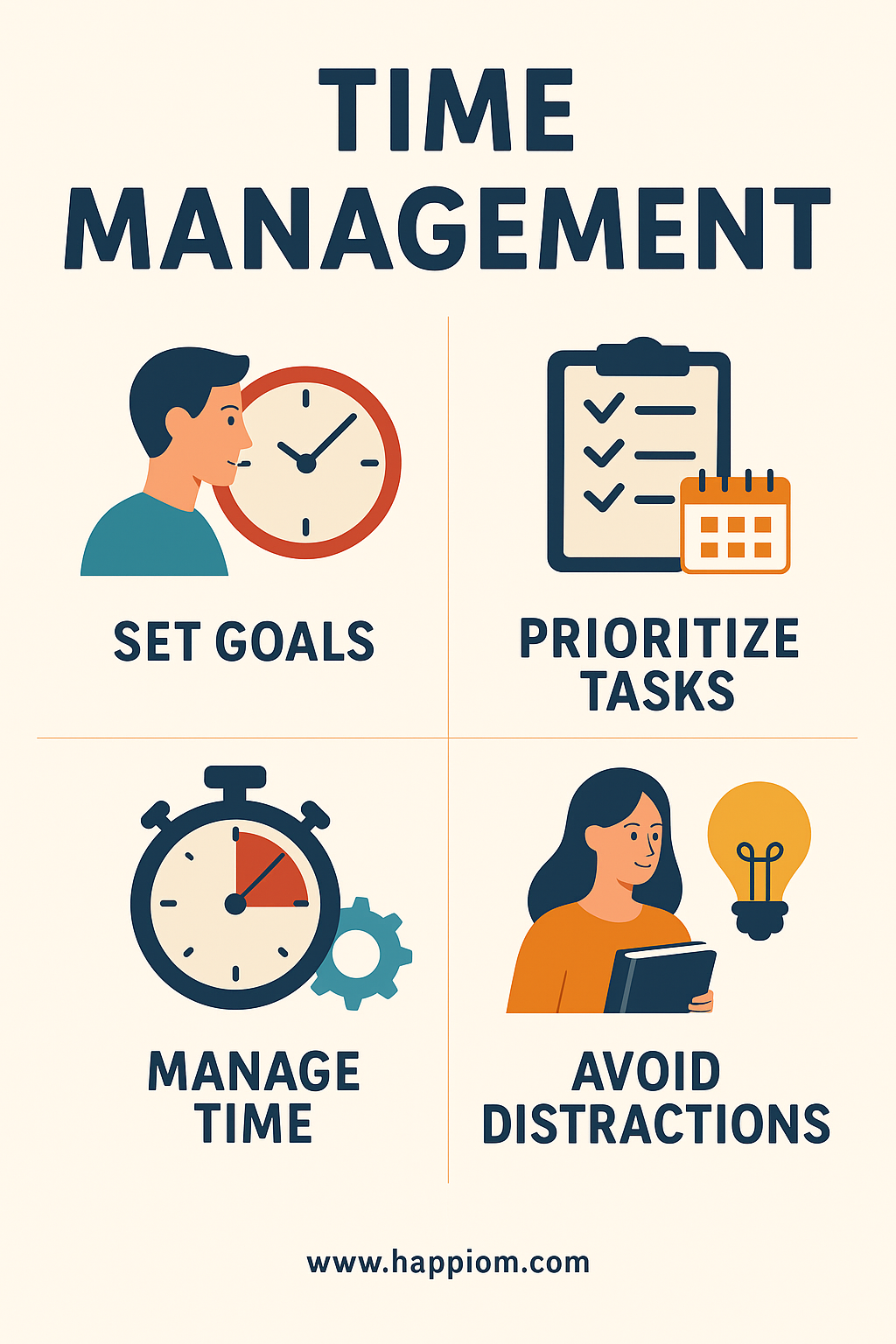
See the below infograpics, which gives clear idea to management your time!
1) Start Your Day with a Plan
The first rule of time management is to know what you want to achieve. Start your day by writing a to-do list or setting priorities. It gives you a roadmap. Without it, you’ll spend time reacting instead of acting. A simple notebook, sticky notes, or apps like Todoist can help you organize your day.
2) Use the Eisenhower Matrix
Not all tasks are equal. Some are urgent, some are important, and many are distractions. Try the Eisenhower Matrix:
– Do first what’s urgent and important.
– Schedule what’s important but not urgent.
– Delegate what’s urgent but not important.
– Eliminate what’s neither urgent nor important.
This simple system saves hours otherwise wasted on low-value work.
3) Break Tasks into Smaller Steps
Big projects can feel overwhelming. Instead of staring at the mountain, turn it into hills. Divide your project into small, clear steps. Completing each step gives you motivation to move forward. Small wins build momentum. When stuck, define the very next physical action (e.g., “draft three bullet points” instead of “write report”).
4) Follow the 80/20 Rule (Pareto Principle)
Often, 80% of results come from 20% of efforts. Identify which activities create the most value and double down on those. For example, a salesperson may find that a few key clients bring most revenue. Focus there first. Trim or batch the rest.
5) Learn to Say No
Many people waste time because they can’t say no. Every “yes” to unimportant work is a “no” to important work. Respect your time. Say politely but firmly: “I don’t have capacity for this right now; can we revisit next week?” Or offer an alternative. Boundaries protect your priorities.
6) Avoid Multitasking
Multitasking feels fast but it’s slow. Context switching breaks focus and increases errors. Do one task at a time with full attention. Finish it. Then move on. You’ll ship faster and with better quality.
7) Use the Pomodoro Technique
If you struggle with focus, try Pomodoro: work for 25 minutes, then rest for 5 minutes. After four cycles, take a longer break. It keeps your energy steady and prevents burnout. Tools like Pomofocus make it easy. Adjust the interval to match your attention span.
8) Prioritize Deep Work
Deep work is focused, distraction-free time spent on meaningful tasks. Schedule 2–3 hours daily for deep work when your energy is highest. Silence notifications. Close social media. Put your phone in another room. Protect this time like a meeting with your future self.
9) Set Deadlines Even If None Exist
Deadlines create useful urgency. If your task has no deadline, set one yourself. Add a checkpoint mid-way. Share the target with a colleague to add gentle accountability. Self-imposed timelines reduce procrastination.
10) Use Technology Wisely
Technology can save time—or steal it. Use it intentionally. Project tools like Trello or Asana help you manage tasks and collaborate. But put limits on chat apps and notifications. Turn off non-essential alerts. Check messages in set windows.
11) Batch Similar Tasks
Switching between different types of work is tiring. Group similar tasks together. Check email at 11:30 and 4:30 instead of every 5 minutes. Make all quick phone calls back-to-back. Batch admin tasks in a single block. This reduces context switching and protects your mental energy.
12) Delegate When Possible
You don’t have to do everything. If someone else can do it better, faster, or at a lower opportunity cost, delegate. Delegation is not weakness; it’s leverage. Provide a clear brief, desired outcome, deadline, and check-in point. Then let people own the work.
13) Keep Meetings Short and Useful
Meetings often eat the day. Always ask: “Is this meeting necessary?” If yes, set a tight agenda, timebox each item, and define the decision needed. Try 15-minute stand-ups for status and async docs for details. End with clear owners and deadlines for next steps.
14) Limit Social Media and Phone Use
Phones and feeds are focus killers. Turn off non-critical notifications during work. Put your phone on Do Not Disturb or in another room during deep work. Use site blockers like Freedom (https://freedom.to/) to limit distracting websites. Every ping steals attention—and attention is your edge.
15) Follow the Two-Minute Rule
If a task takes less than two minutes, do it now. Reply to a short email. File that PDF. Rename the document. Clearing these micro-tasks immediately reduces mental clutter and keeps your system clean.
16) Take Regular Breaks
Rest is part of productivity. Long hours without breaks reduce focus and creativity. Take short movement breaks. Stretch. Walk for five minutes. Drink water. A refreshed brain makes better decisions and works faster. Recovery is not a reward; it’s fuel.
17) Maintain a Healthy Work–Life Balance
Time management is not just about cramming more into the day. It’s about sustaining performance. Prioritize sleep, nutrition, and exercise. Build social time and hobbies into your week. A healthy mind and body amplify your efficiency and resilience at work.
18) Review and Reflect Daily
End the day with a 10-minute review. What did you ship? What slowed you down? What can you improve tomorrow? Capture lessons and adjust your plan. Weekly, do a bigger review: clean your task list, close loops, and set three key goals for the coming week. Reflection compounds. Use an app like Happiom daily.
19) Automate Repetitive Work
Many tasks are repetitive: scheduling, file backups, reporting, data entry. Use automation tools to save time. Try Zapier or IFTTT for cross-app workflows. Use email filters and templates. Create checklists for recurring tasks. The less manual work, the more time for creativity.
20) Build Consistent Habits
Time management is not a one-time trick. It’s a set of habits. Plan daily, review weekly, and improve monthly. Keep your system simple so you’ll actually use it. Discipline creates freedom. Over time, good habits turn into autopilot, and productivity feels natural.
Practical extras you can apply today:
– Block your calendar for deep work. Treat it like a meeting.
– Pick tomorrow’s top three tasks before you end today.
– Keep a “parking lot” list for ideas and distractions while you focus.
– Use keyboard shortcuts to save minutes that become hours.
– Tidy your digital workspace weekly: desktop, downloads, inbox.
A sample daily flow:
1. Morning (High Energy): Deep work on your most important task for 90–120 minutes. No email, no chat.
2. Late Morning: Message check, quick responses, scheduling. Two-minute tasks done immediately.
3. Early Afternoon: Collaborative work, meetings (short and agenda-driven).
4. Mid Afternoon: Admin and batching (email, tickets, approvals).
5. Late Afternoon: Wrap-up, daily review, set top three for tomorrow.
Handling interruptions:
– If a colleague interrupts, note the request, offer a time block later, and return to your task.
– If it’s urgent, pause intentionally: mark your place, set a quick timer, and come back as soon as possible.
– For self-interruptions, keep a scratchpad. Write the thought down instead of acting on it.
Email sanity:
– Turn off auto-check. Open email at set times.
– Use folders or labels for quick triage: “Action,” “Waiting,” “Read Later.”
– Write shorter emails with clear asks, bullets, and deadlines. Clarity reduces back-and-forth.
Task clarity checklist (before you start):
– What is the outcome?
– What does “done” look like?
– What is the first physical action?
– What is the deadline and check-in?
– What could block me, and how will I remove it?
Mindset shifts that help:
– Progress over perfection. Shipping v1 beats polishing v0 forever.
– Time is a budget. Spend it where it matters.
– Energy is as important as hours. Align hard tasks with peak energy.
– Systems beat willpower. Design your environment for focus.
Final Thoughts
Time management is not about squeezing every second. It’s about working smart, protecting focus, and aligning your actions with what truly matters. By applying these 20 tips, you can increase productivity, reduce stress, and enjoy more control over your day. Remember, time is your most valuable resource. Use it wisely, and you’ll achieve more with less effort. Start small, stay consistent, and soon managing time will feel natural.
Which tip will you try first?